| Tinkimintz Expedition
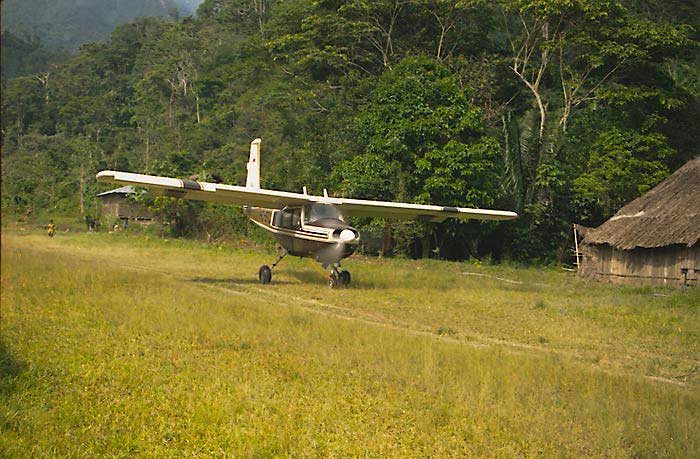
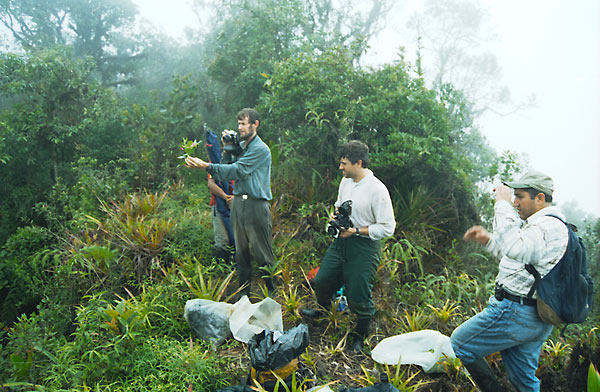
We landed at the tiny settlement of
Tinkimintz, at 840m, and the residents were quite open to our
request to investigate their mountains. Raul, the young leader
of the village, made us hire all the adult male villagers as
porters, so that he would not be accused of showing favoritism.
Lucky for us the village was small, and as it turned out we
needed everyone who came.
The forest close to Tinkimintz was not rich
in epiphytes. I believe this west-facing slope experiences a
rain shadow effect. Almost no orchids were in flower here. Genera
present here included Pleurothallis and Stelis,
Oncidium, Maxillaria, and members of the subtribe
Stanhopeinae. A large flowering pink Paphinia
was too high to reach.
Beginning at the ridge crests above about
1500m the epiphyte diversity and number of individuals began
to increase, but the majority of plants found were sterile.
The widespread Lepanthopsis acuminata was present here,
along with a few Stelis species and a sterile Scelochilus.
There was also a sterile terrestrial in the subtribe Goodyerinae,
with blackish leaves speckled salmon. I brought it into cultivation
but it did not survive.
From about 1700m to about
1850m the epiphyte diversity was reasonably high. More species
of orchids were in flower than at lower elevations. One of the
most common Lepanthes on the ridge was L. series,
an otherwise extremely rare species previously known only from
two specimens found between Yangana and Vallodolid and one plant
I had found on the Gualaceo-Limon road. (I have also just recently
found some specimens in the Pastaza watershed of east-central
Ecuador.)
After two days of climbing, our ridge
hit the base of a large white sand mesa. The very mossy forest
here was probably kept moist by condensation from winds cooled
by their rise over the mountain which is capped by this mesa.
This forest along the base of the mesa contained two beautiful
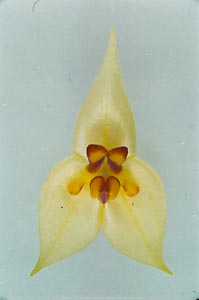
new species of orchids, a Maxillaria
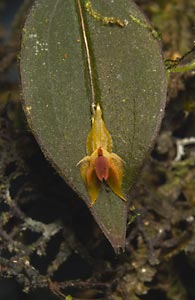
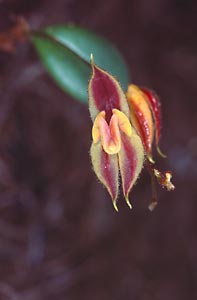
(LJ 3133) and a Lepanthes
(LJ 3154).
The Maxillaria has now been described by Dr. Calaway
Dodson as M. jostii, and I have published the Lepanthes
as L. neillii (see New
Pleurothallid Orchids from the Cordillera del Condor of Ecuador).
Many other pleurothallid orchids were present here, including
five or six species of Stelis, Ophidion pleurothallopsis,
an unremarkable Platystele, many Lepanthes,
and some Brachionidium species. Besides the new Lepanthes
species just mentioned, there were L. surrogata (apparently
endemic to the Condor and previously known only from two collections
at 1500m east of Guisme), L. cf tectorum,
L. orchestris, L. monitor, L. papyrophylla,
and L. bifalcis. The Brachionidium species
were very small. LJ 3061 is very like B. ballatrix,
known only from the type specimen from Nambija. LJ 3028 is closest
to widespread B. folsomii but with some differences
in petal ciliation and other details.These are both with Dr.
Luer, awaiting positive identification.
Several plants of Schlimmia
condorana were also found here. This species, previously
known from only two specimens, is restricted to the province
of Zamora, though not strictly to the Cordillera del Condor.
There were also many sterile plants resembling widespread Oncidium
globuliferum, and sterile plants of a species of Otoglossum.
The sides of the sandstone
mesa were nearly vertical, but with the help of our Shuar guides
we were able to reach the top by climbing a narrow gully. What
a strange flora we found up there!!! The "forest",
if it could be called that, was only slightly taller than us,
and some of the terrestrial Sobralia ciliata orchids
grew much taller than the trees. The soil was just white sand
with almost no organic material, and I suppose there were not
enough nutrients to grow big trees. The ground was covered with
orchids and bromeliads, and one of our group, Jose Manzanares,
discovered several new bromeliads there. At first, the orchids
were not very diverse, in spite of the high number of individuals.
There were Stelis, Pleurothallis, Maxillaria,
Elleanthus, Epidendrum, and Scaphyglottis.
Lepanthes series continued to be common here. There
were also some sterile Trichosalpinx and Lepanthopsis.
Three members of the Oncidium alliance were also common
here: the scandent Oncidium resembling O.globuliferum,
a Cyrtochilum, and an Otoglossum. None had
flowers, but the Otoglossum had buds which, when dissected,
resembled O. coronarium.
As we reached the highest parts of
the mesa, at 2000m, the forest quite suddenly became mossy and
diverse, with many species of pleurothallid orchids. Among them
I found Scaphosepalum globosum, at that time thought
to be a Condor endemic. We have since found it in the Sacha
Llanganates of east-central Ecuador. Along with S. globosum
I found a second species of Scaphosepalum with characters
closest to S. tiaratum, which is known only from the
type collection several thousand kilometers north of the Condor.
There was also Porroglossum hystrix, a recently described
species endemic to the Condor and neighboring mountains. Several
Brachionidium were also found here, but as often happens
with Brachionidium, they were not in flower. One of
them has flowered in cultivation and turns out to be B.
capillare. Also alive in my greenhouse are two Masdevallia
species as yet unidentified; one vegetatively resembles M.
condorana. Lepanthes here included widespread
L. tachirensis, omnipresent L. mucronata,
rare L. papyrophylla, and a few other nonflowering
species. There were also many species of Stelis here,
some Pleurothallis, Platystele, Brachionidium,
Scaphyglottis, Epidendrum, Maxillaria, Elleanthus, Baskervilla,
and Dichaea. Click
here to see the collection data for this trip.
There was still another much higher
sandstone mesa beyond this one, but the topography was difficult
and we were out of time. There are surely many interesting things
waiting there for some intrepid explorer.
|