| The Tapichalaca Reserve
The Tapichalaca Reserve is on the
Yangana-Valladolid road just south of Loja, in the province
of Zamora near Ecuador's border with Peru. It happens to include
a famous mountain pass that has been the focus of much botanical
work over the last century and a half, and the area is one of
the richest in Ecuador for orchids. One could say that the reserve
is even more important for orchids than for birds. An astonishing
29 species of orchids appear to be strictly endemic to the reserve
and the immediately surrounding forest--- in other words, these
29 species have never been found anywhere else on earth. ( I
include in this total some species that have been found near
Valladolid just below the present boundaries of the reserve,
but since there are plans to extend the reserve downward, I
think it is useful to include these.) Click
here to see a table of these special orchids,
with their elevations and the year they were last seen.
Most of these species were discovered in the 1980s as the area
opened up, and most have not been seen again since that time.
They should be considered endangered, considering the current
rate of deforestation in the region and the lack of recent records.
(My principle reference for this table is the Libro
Rojo de Plantas Endemicas del Ecuador 2000, R.
Valencia, N. Pitman, S. Leon-Yanez, and P. Jorgensen (eds),
orchid chapter by L. Endara, Publicaciones del Herbario QCA,
Pontificia Universidad Catolica del Ecuador, Quito. This is
supplemented and corrected by Dr Calaway Dodson's unpublished
Orchids of Ecuador database, updated
Dec. 2002 and kindly provided to me by Dr Dodson.)
 |
| Epidendrum dalessandroi has
only been found in the Tapichalaca Reserve and the
immediately surrounding area. |
|
I went to Tapichalaca
with the directors of the Jocotoco Foundation for one and
a half days in March 2003. On this very brief initial visit,
I was able to find four of these rare restricted-range species
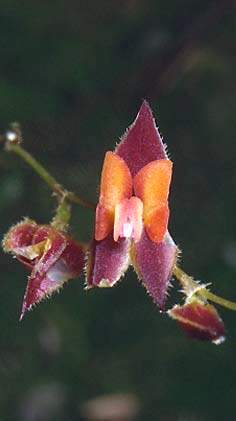
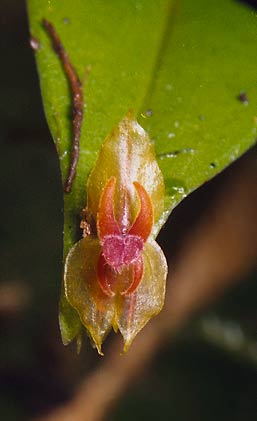
of orchids: Lepanthes exogena, Lepanthes ejecta,
Pleurothallis vegrandis, and Epidendrum dalessandroi.
Lepanthes exogena had last been seen in 1985, and
Lepanthes ejecta had last been seen in 1986. Both
were relatively common in less-disturbed forest near the
Casa Simpson, the research station inside the reserve. Epidendrum
dalessandroi grew in the same spot. Pleurothallis
vegrandis had only been known from the original type-specimen
collected in 1985; I found a single plant of it. These findings
suggest that most of the other 25 Tapichalaca endemics also
still survive somewhere in the reserve, though disturbance
near the road and along accessible ridgelines has probably
eliminated the populations that were found in the 1980s.
The absence of collections of these species in recent years
highlights the danger they face from regional deforestation.
It is very clear that Tapichalaca is a globally important
reserve for the region's plants as well as for its birds. |
|
| Lepanthes
exogena, apparently found only
in the Tapichalaca Reserve. |
|
|
|
|
| Lepanthes
ejecta, another species found
so far only within the Tapichalaca
Reserve. |
|
|
|
Click here for my collection data for this reserve,
with identifications and photos as they become available.
|