Taxonomic Issues
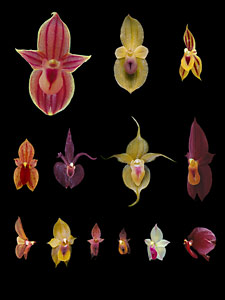
It is not easy to decide how to group these highly variable plants into discrete species. It helps to think carefully about the definition of a species. A species can be thought of as the largest possible group of individuals who freely exchange genes with each other. Two populations that live together yet rarely or never exchange genes with each other are seperate species biologically, no matter how similar they might seem to us. See What is a Species? in my Teagueia Explosion article. Many of the new Teagueia species are clearly distinct, and I do not feel uncertain about their status. I am confident about the status of the following species: T. alyssana, T. amplectans, T. ciliata, T. cymbisepala, T. dactylina, T. deflexa, T. gracilis, T. magnifica, T. negristellata, T. pailinii, T. scorpioidea, and T. shepardii. Each of these is morphologically distinctive, without intermediates connecting them to other forms, and without significant structural variability. These species are not discussed further in this section on taxonomic problems. The following species show quite a lot of variability and may actually contain two or more species: T. angustipetala, T. cherisei, T. hemispherica, T. jostii, and T. protuberans. Some of these show significant variation from one mountain to the next (T. hemispherica, T. jostii) but show little variation within a population. The others show quite a lot of variation even on the same mountain. The following sympatric species pairs are very similar: T. aliana / pseudoaliana, T. grossilabia / angustipetala, and T. aurata / grossmanii. Since T. aliana and T pseudoaliana grow intermixed in the same areas, yet maintain consistent differences, I conclude that they are not freely exchanging genes and are good species, even though they are very similar to each other. The situations of the other two species pairs are not as clear and require more study. The following species groups grow on different mountains and so their differences might be explainable as geographic variations: T. micrantha / protuberans / gracilis, and T. sancheziae / platysepala. The following species pair clearly hybridizes and has many intermediate forms, yet the extreme forms are very different from each other: T. barbigera / aurata. In this case it will perhaps be best to recognize the whole group as a single hybrid swarm. In the following weeks I will elaborate on these issues for each problematical species. |